Translate

Showing posts with label liver. Show all posts

Wednesday, April 20, 2016

The A-Files, Alcohol A-Z for Alcohol Awareness Month: Quitting protects the liver


Twenty-six episodes of 'The A-Files' air throughout Alcohol Awareness Month on YouTube, Facebook, LinkedIn, Alcohologist.com and AddictedMinds.com, among other web and social media sites. Episode Q is on quitting to protect the liver. The liver is a resilient, tough toxin eradicating giant, but it will let you know when it's had enough punishment. 

Here are four tells of alcohol-related liver damage.
1) Waste elimination issues. Bloody or black stool is a sign you've damaged something. Dark urine, light-colored diarrhea are more common. They're caused by your body dumping bile, which it over produces to combat the toxin. The yellow is from bilirubin, a pigment in the bile. Urine will be dark when you're dehydrated. Consistently dark urine is a liver warning sign.
2) Bilirubin makes you appear jaundiced, which is a yellowing of tissues. The first place you'll notice this is the whites of the eyes.
3) A swollen and/or sensitive abdomen is a telling sign you're pretty far down the path on alcohol-related liver damage. The liver is located mostly behind the ribcage, and when it swells in size it will force your other organs down to the softer belly.
4) If you tire easily or feel fatigued, the body is working overtime and channeling energy to remove alcohol and its toxic byproduct just to survive. This is the most common symptom, and most overlooked one.

Cirrhosis is what people commonly think of with drinking and liver damage, but only one in 10 alcoholics develops cirrhosis. It's not the only alcohol problem. A fatty liver occurs when alcohol consumption disrupts how the body chooses its fuel. Cells normally use fat to produce energy. As acetaldehyde breaks down in the body it releases hydrogen, which mitochondria use before fat as fuel. The unused fat then accumulates around the liver, choking it. Alcoholic hepatitis is a third type of liver injury.

Liver trouble is not just a problem for those with the disease of alcoholism. Binges and so-called 'social drinking' also damage the liver. The liver is the main metabolic site in the body, so it has a 'domino effect' on many organs, especially during a bender. "Binge-induced liver injury impacts other organs as well, a view rather poorly appreciated by the public,” according to authors of a 2013 study appearing in Alcoholism: Clinical and Experimental Research. Those other organs? Can you think of one that isn't important?
The entire 26 episode HD series is available on disc, along with fact sheets, for helping professions. See the preorder special at tr.im/AFiles

Visit alcohologist.com for a replay of CBS Sports' Power Up Your Health featuring Scott Stevens.  Another interview is on Alcohol Awareness.  Syndicated radio program Savvy Central Radio did this interview, too. Lucy Pireel's "All That's Written" included a feature called "When alcohol doesn't work for you anymore."  Details on the third literary award for Every Silver Lining Has a Cloud and the first for Adding Fire to the Fuel also can be found on www.alcohologist.com. Download the FREE Alcohology app in the Google PlayStore today. Stevens also is the public relations officer with AddictedMinds.com 

Sunday, January 3, 2016

Binge vs. daily drinking: Which is riskier?

It's common knowledge that alcohol causes damage to the liver, the organ primarily responsible for handling the toxin. The University of Missouri School of Medicine took a look at the damage caused by daily drinking versus the damage from binge drinking. Their November 2015 report published in the journal, Biomolecules, was significant considering the most common form of alcohol use or abuse in the U.S. is binge drinking. In fact, the Centers for Disease Control and Prevention (CDC) reports approximately one in six adults binge drinks about four times each month.

The researchers at Mizzou concluded that daily alcohol use and repeat binge episodes caused moderate liver damage when compared to a control group not exposed to alcohol. “This outcome came as no surprise,” say the researchers. “However, in the mice exposed to both chronic use and repeat binge episodes, liver damage increased tremendously.” Even more 'shocking' – in the researchers' own words – was the extent of fatty deposits in the livers of those exposed to chronic plus binge drinking. It was approximately 13 times higher than the control group.

The amped-up fat accumulation was in part caused by changes within the liver which not only increased fat deposits, but increased stress on the organ while decreasing the liver’s ability to fight the stress. Chronic and excessive alcohol use shouldn't be associated only with liver damage. Drinking alcohol excessively can create an inflammatory response to the liver and other organ systems in the body and when those organs work at a lower level of function, then a whole host of physiological processes can be affected including diabetes, cardiovascular disease and eight forms of cancer… all of which were covered in various prior episodes of The Sobriety :60+.

By way of background, both types of drinking on their own are going to do damage, but evidence-based studies disagree on which is worse. Long-term daily drinking, rather than weekly binge drinking, is by far the biggest risk factor in serious liver disease, according to a 2009 report from the University of Southampton. A 2011 University of Rochester study found binge drinking worse for the heart, increasing bad cholesterol and causing 60 percent more artery blockages than abstainers.

The new UM study says both produce ugly results on their own, but combining daily and weekly binge drinking is worse. If you're curious as to how long you have to drink in these patterns to do the damage or increase health risk, the answer is simple: Alcohol is a toxin and the damage begins with day one, drink one. How much damage? Less if you quit today, more if you wait until tomorrow.
Visit alcohologist.com for a replay of CBS Sports' Power Up Your Health featuring Scott Stevens.  Host Ed Forteau led a discussion on risky myths of about "healthy" drinking.  Lucy Pireel's "All That's Written" included a feature on Every Silver Lining Has a Cloud called "When alcohol doesn't work for you anymore."  Details on the third literary award for Every Silver Lining Has a Cloud and the first for Adding Fire to the Fuel also can be found on www.alcohologist.com. Download the FREE Alcohology app in the Google PlayStore today. Stevens also is the public relations officer with AddictedMinds.com and works with TheAddictionsAcademy as well.

Saturday, November 7, 2015

Dying for a drink: The alcohol death toll this weekend by the numbers... it's way more than impaired driving

Now that Halloween is out of the way (a huge drinking holiday when it falls on a weekend, by the way) it's time to get to a real-life scary story. (Read the enitre article online) By the numbers, alcohol is going to claim more lives this weekend than any other drug – in fact, more than all of the illicit drugs combined. Recent news items have focused on the $250 billion annual cost to the U.S. in hard-dollar expenditures and lost productivity. The death toll is a more human, and more frightening, story. In a single weekend, there are:
  • 15 alcohol overdoses – The Centers for Disease Control and Prevention's (CDC) Vital Signs puts it starkly: 2,200 die every year from drinking too much, too fast. Very high levels of alcohol – a central nervous system depressant drug – shut down the brain's control of critical body functions, leading to death for an average of six people every day. (Watch The Sobriety :60+).
  • 43 murders – According to the Bureau of Justice Statistics' (BJS) report Alcohol and Crime, for more than four in 10 convicted murderers, being held either in jails (43.7 percent) or in state prisons (41.4 percent), alcohol use is reported to have been a factor in the crime. The younger generations are the most at risk: 95 percent of all violent crime on college campuses involves the use of alcohol by the assailant, according to the National Council on Alcoholism and Drug Dependence (NCADD).
  • 75 “unintentional” deaths – Theses are falls, drug interactions, fires, suffocation/choking and drowning deaths. They account for 22,000 deaths every year… half of them involve alcohol use. As cited in alcoholism recovery book, Every Silver Lining Has a Cloud, "58 percent of fire fatalities have alcohol in their systems, which presumably kept them from fleeing safely and 45 percent of drownings are alcohol-related.”
  • 110 car wreck fatalities – A little under one in three fatal car wrecks is alcohol-related (31 percent). Sometimes, it's a single-car accident with only one occupant: The impaired driver. Fate doesn't always work that way. While tragic for the family of that driver, media attention usually shines the spotlight on the unimpaired victims of an impaired driver. From 6 p.m. Friday to 6 a.m. Monday, 110 people die on an average weekend as a result of drinking and driving. The numbers are higher the weekends between Thanksgiving and New Year's… slightly lower the rest of the year… and 15 percent lower on weekdays.
  • 136 cancer deaths – Approximately 560,000 people died from cancer in 2009, the year for which the researchers analyzed alcohol-related cancer death rates in a related article. Of those deaths, nearly 20,000 were caused by alcohol-linked cancers. Breast cancer accounted for the most common alcohol-related cancer deaths among women, contributing to 15 percent of all breast-cancer deaths. Among men, cancers of the mouth, pharynx, larynx and esophagus accounted for the most alcohol-linked cancer deaths.
  • 227 liver disease deaths – Cirrhosis is the 12th leading cause of death in the United States, but it isn't a synonym for another disease: Alcoholism. Alcohol use, not necessarily alcohol dependence, is the primary cause of all liver diseases including cirrhosis. The amount of alcohol that can injure the liver varies greatly from person to person. In women, as few as two to three drinks per day have been linked with cirrhosis and in men, as few as three to four drinks daily. By CDC records, in 2013, there were 71,713 total liver disease deaths among individuals aged 12 and older and 46.4 percent involved alcohol. Among males, 48.9 percent of the 46,240 liver disease deaths involved alcohol. Among females, 42.7 percent of the 25,433 liver disease deaths involved alcohol.
Ignoring even more alcohol-related deaths from stroke and heart disease (no, alcohol is not hearth healthy, see 2014 Examiner article) that is an average of one alcohol related death every six minutes from quitting time Friday until wake-up time Monday. The weekend total: 606. The number preventable: 606.

Visit alcohologist.com for a replay of CBS Sports' Power Up Your Health featuring Scott Stevens.  Host Ed Forteau led a discussion on risky myths of about "healthy" drinking.  Lucy Pireel's "All That's Written" included a feature on Every Silver Lining Has a Cloud called "When alcohol doesn't work for you anymore."  Details on the third literary award for Every Silver Lining Has a Cloud also can be fou.nd on www.alcohologist.com, plus the NEW book, Adding Fire to the Fuel, is now available. Download the FREE Alcohology app in the Google PlayStore today

Sunday, August 2, 2015

Four signals of alcohol-related liver damage


If the liver had pain nerves, nobody would ever take a second drink.  The stuff is that toxic. Spill a drop in a cut or an accidental splash in the eye will demonstrate what I mean.  The liver is a resilient, tough toxin eradicating giant, but it will let you know when it's had enough punishment. (Read the transcript or share the YouTube video )

Here are four tells of alcohol-related liver damage.
1) Waste elimination issues.  Bloody or black stool is a sign you've damaged something.  See a doctor immediately. Dark urine, light-colored diarrhea are more common.  They're caused by your body dumping bile, which it over produces to combat the toxin.  The yellow is from bilirubin, a pigment in the bile. Urine will be dark when you're dehydrated.  Another issue associated with alcohol.  But consistently dark urine is a warning sign your liver is in danger.  Also, bilirubin is eliminated in sweat. A white shirt will look yellow in the arm pit.

2) Bilirubin also makes you appear jaundiced, which is a yellowing of tissues.  The first place you'll notice this is not the skin, but the whites of the eyes.  Fingernails also can yellow.

3) A swollen and/or sensitive abdomen is a telling sign you're pretty far down the path on alcohol-related liver damage.  The liver becomes fatty.  It's located mostly behind the ribcage, and when it swells in size it will force your other entrails down to the softer belly.  Cirrhosis also builds up fluid in the abdomen as well.

4) If you tire easily or feel fatigued, blame the alcohol.  It doesn't just clobber your sleep, as covered in previous episodes of The Sobriety :60+.  The body also is working overtime and channeling energy to remove alcohol and its toxic byproduct just to survive.  This is the most common symptom, and most overlooked one until it is joined by some of the other ones.

These conditions can be the results of other health challenges, but if you're a drinker, the obvious solution is usually the right one: Quit.  What causes problems, is one.

Visit alcohologist.com for a replay of CBS Sports' Power Up Your Health featuring Scott Stevens.  Host Ed Forteau led a discussion on risky myths of about "healthy" drinking.  Lucy Pireel's "All That's Written" included a feature on Every Silver Lining Has a Cloud called "When alcohol doesn't work for you anymore."  Details on the third literary award for Every Silver Lining Has a Cloud also can be found on www.alcohologist.com, plus the NEW book, Adding Fire to the Fuel, is now available. Download the FREE Alcohology app in the Google PlayStore today.

Monday, January 26, 2015

The Sobriety :60+ #25: Junk science vs. facts on alcohol and heart, liver health


A "study" a week ago said daily drinking (e.g. drinking alcoholically) is a heart-failure beater. Evidence today shows how it mauls the liver. Read the transcript or watch the short episode on YouTube.

Visit alcohologist.com for a replay of CBS Sports' Power Up Your Health featuring Scott Stevens.  Host Ed Forteau led a discussion on the health risks and myths of health benefits of drinking.  Lucy Pireel's "All That's Written" included a feature on Every Silver Lining Has a Cloud called "When alcohol doesn't work for you anymore."  Details on the third literary award for Every Silver Lining Has a Cloud also can be found on www.alcohologist.com, plus an interview with Christoph Fisher Books.  Mr. Fisher is an acclaimed international author from the UK, among his works is the Alzheimer's book "Time to Let Go."  Download the FREE Alcohology app in the Google PlayStore today.

Sunday, April 6, 2014

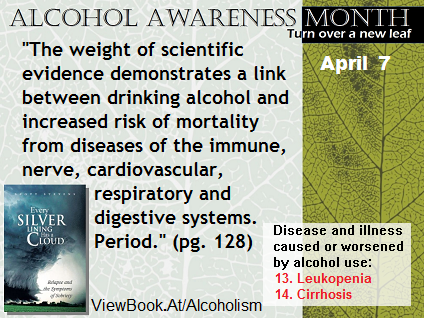
Alcohol Awareness Month: April 7


Scroll down for the replay of the Dr. Jeanette Gallagher show feature with Scott Stevens. Lucy Pireel's "All That's Written" included a feature on Every Silver Lining Has a Cloud called "When alcohol doesn't work for you anymore."  Details on the third literary award for Every Silver Lining Has a Cloud can be found on www.alcohologist.com, plus an interview with Scott Stevens on Health Media Now and one at Christoph Fisher Books.  Mr. Fisher is an acclaimed international historical fiction novelist from the UK.  
 
SAVE THE DATE:  Scott Stevens will be part of the opening night symposium for the REEL Recovery Film Festival San Francisco.

Saturday, September 28, 2013

SATURDAY REWIND: Other organs risked by binge drinking, not just the liver

The following article from the alcohol research news archive takes a look at other organs at risk from episodes of heavy drinking.


Alcoholic liver disease (ALD) covers a range of diseases such as fatty liver, hepatitis and cirrhosis. All are commonly linked to alcohol abuse or the disease of alcoholism. A January 22 review of studies addressing the effects of binge drinking on the liver underscores the complex interactions among various damages done to the liver by binge drinking.

Results published in the April 2013 issue of Alcoholism: Clinical & Experimental Research and are part of the first review that highlights the changes at the molecular level that occur in the liver from excessive alcohol use.

Binge drinking is defined by the U.S. Centers for Disease Control and Prevention (CDC) as four or more drinks in an episode for women, five or more in an episode for men.

Binge drinking is on the rise worldwide, and is particularly common in the U.S. A recent study, reported on examiner.com in early 2012, shows it is a rising – and risky – problem for women, but men are statistically more prone to binge drinking and are also at risk. Teen and young adult binge drinking is also a statistical headache for those in the alcohol abuse prevention profession.

"The liver is the main metabolic site in the body," said Shivendra D. Shukla, Margaret Proctor Mulligan Professor at the University of Missouri, School of Medicine and lead author for the study. "It is involved in the physiological functions of organs such as the heart, kidney, blood vessels and brain. ALD-affected liver chemicals can also influence immunity, cardiovascular health and coagulation. Thus, ALD can have a 'domino effect' on many organs."

The liver is also the major organ for alcohol metabolism, and as such, is the first line of defense against excessive alcohol consumption.

New studies from both experimental animals and humans indicate that binge drinking has profound effects on the liver. This is in addition to the known dangers of acute levels of alcohol. "Chronic alcohol consumption renders the liver highly susceptible to binge-induced liver damage," said Shukla. "Binge-induced liver injury impacts other organs as well, a view rather poorly appreciated by the public."

Shukla said, "This review also sets the stage for additional investigations in this field. The cross-organ implications of binge-induced liver damage must be explored."

Binge drinking can cause changes at the cellular level, in the mitochondria – the power-plant of all living cells. It can result in cell death as a result, and otherwise has a snowball effect in other organs because of the liver’s role in removing toxins from the body. Added Zakhari. "Therefore, people should not binge drink, especially on an empty stomach, and if they are chronic heavy drinkers, binge drinking will exacerbate liver injury, especially if (conditions) such as obesity, Hepatitis C or HIV infection exist."

"We hope this will encourage research and development of newer approaches and tools to control and ameliorate binge-induced health effects,” said the researchers.

The alcohol user is eight times more likely to get cirrhosis, which is irreversible, incurable and fatal. Not all Alcoholics will get it. Only one in 10 develops cirrhosis. However, it is not the only liver disease cause by alcohol. A fatty liver occurs when alcohol consumption disrupts how the body chooses its fuel. Cell mitochondria – our body power plants – normally use fat to produce energy. As acetaldehyde breaks down in the body it releases hydrogen, which mitochondria use before fat as fuel. The unused fat then accumulates around the liver. Even in someone who doesn’t look fat in their extremities or midsection, fat deposits choke the liver.

Alcoholic hepatitis is a third type of liver injury connected to alcohol misuse. It is a condition similar to the other hepatitis diseases, but is not the same as A, B or C hepatitis.

“Lest you think these three liver problems are the realm of only the hard drinker, they can be stimulated by amounts of alcohol between seven and 13 ounces of whiskey – five to nine shots or mixed drinks – in 24 hours,” according to the book, Every Silver Lining Has a Cloud: Relapse and the Symptoms of Sobriety. “There are very few symptoms of liver injury until it becomes chronic because the liver has no pain nerves to tell you when it is hurt. If the liver had nerve endings, you’d never make it to the second drink.”
-- from examiner.com (full article)

www.alcohologist.com